In short: Hermes 3000 now lets you write your own cookbook or baking book. A recipe is a block of its own with ingredients, method, servings and times – a form in the editor, set like a cookbook page in print. Recipes you already collected in Plauderküche come into your book through a share link, photo and all. The video below shows it in one minute.
Almost every family has them: index cards with grease stains, a notebook in grandma's handwriting, recipes only one person still knows by heart. And almost every family has said it at some point: "One day we should turn these into a proper book."
In writing software that used to be a chore. Recipes aren't running text: ingredients need amounts and units, steps need an order, and the printed page has to stay readable with flour on your hands. That is exactly what the new recipe block in Hermes 3000 is for.
The video: your cookbook in one minute
▶ Watch the video: Write a cookbook – recipes and import from Plauderküche (1 minute) – or as a short in under a minute.
In the video, a small family cookbook takes shape: "From Grandma's Kitchen" with Grandma's apple cake, a lentil soup created right in the editor, and a mushroom pasta brought in from Plauderküche.
A recipe is a block of its own
You can add a recipe anywhere in a chapter: type slash recipe ("/recipe") while writing, or use Add block → Recipe. A form opens with everything a recipe needs:
- A name and a short introduction – where the recipe comes from, when it was made
- Servings, prep time and cooking or baking time
- Ingredients with amount, unit and ingredient in separate fields
- Steps, numbered automatically
- Tips and variations at the end
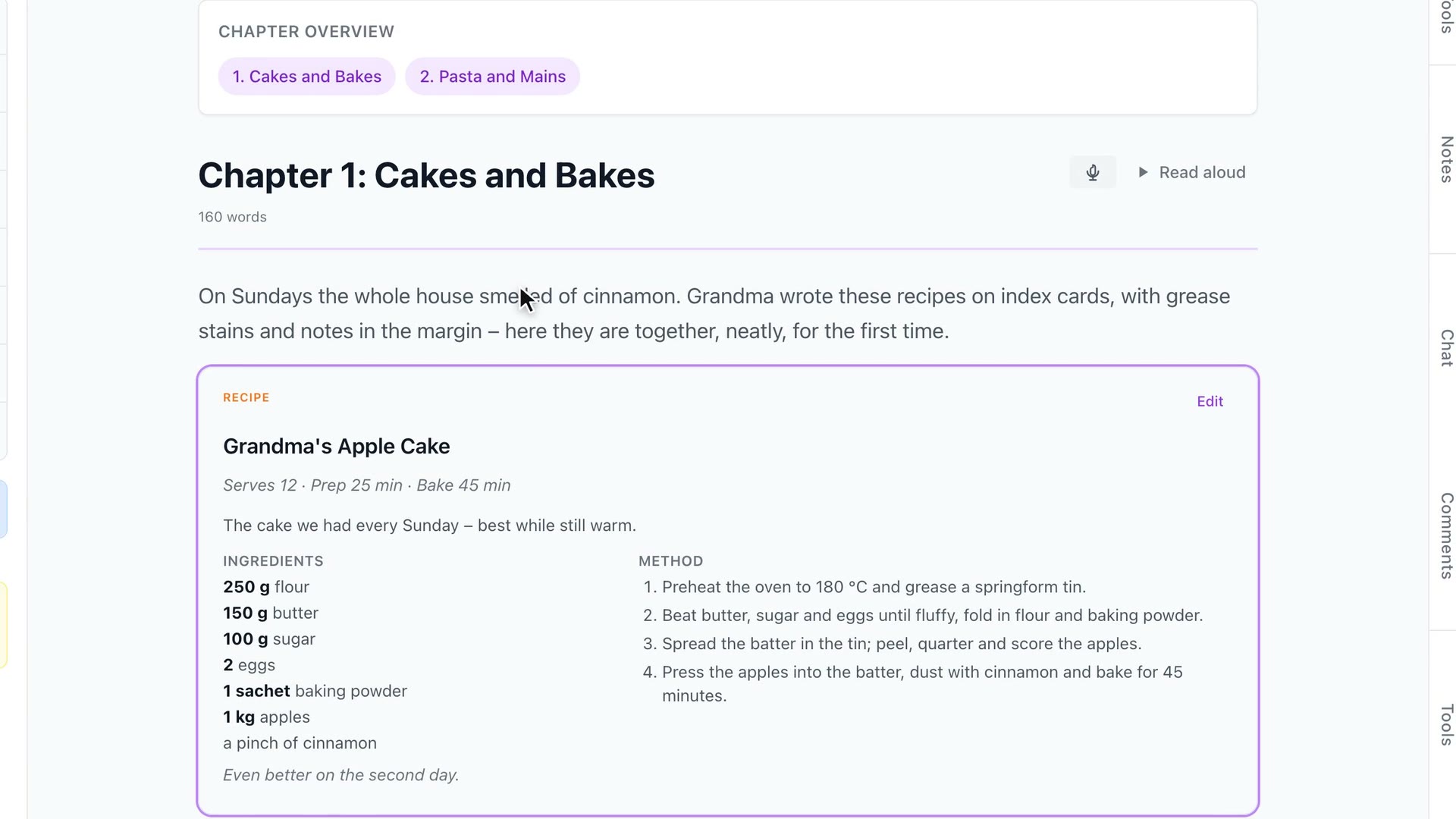
You don't have to type an existing ingredient list line by line: just paste it, and every line becomes an ingredient. Hermes splits off amount and unit where that is unambiguous – "500 g flour" becomes 500 · g · flour, "3 eggs" stays 3 · eggs.
Click Done and the form turns into the recipe view: ingredients on the left, method on the right, amounts in bold, just like in a printed cookbook.
Taking recipes over from Plauderküche
Plauderküche is our cooking app: you collect recipes there, scan them from a photo, get suggestions and cook hands-free with the kitchen AI. If your recipes already live there, you don't have to type them again for your book.
Here's how:
- In Plauderküche, share a recipe – or use share several for a whole collection.
- In Hermes, type slash Plauderküche ("/plauderküche") or choose Add block → Recipe from Plauderküche.
- Paste the link and click Load – Hermes shows a preview with ingredients, steps and photo.
- Add to book. The recipe sits in your chapter, and the photo also goes into the book's media library.
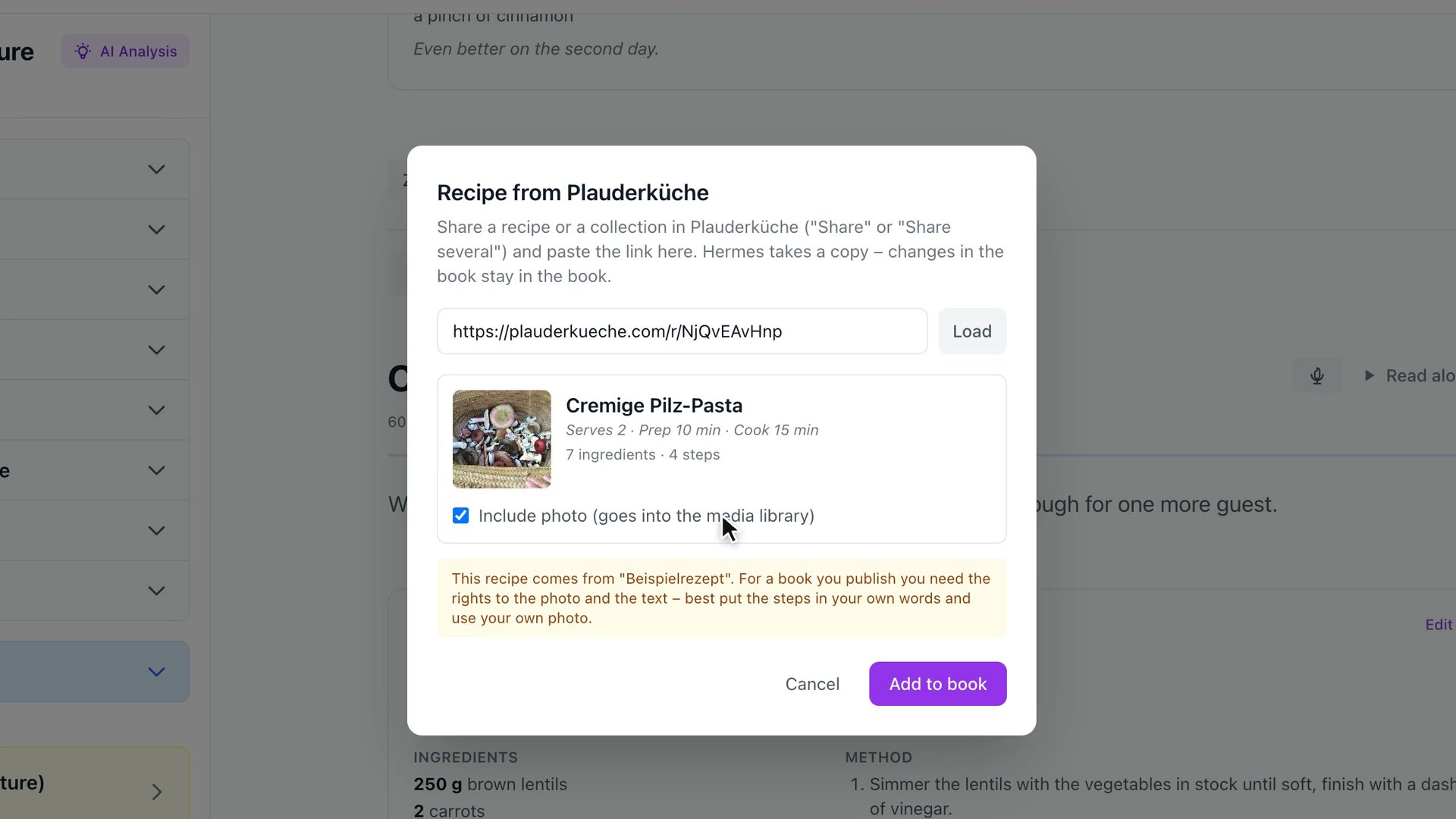
With a collection, every recipe becomes a block of its own, and you can leave out individual ones. And because it is a copy, not a live connection, whatever you change in the book stays in the book – the original in Plauderküche stays as it was.
A word on rights to recipes and photos
Recipes from the web, from cookbooks or from social media usually belong to someone else – especially the photo and the exact wording. Hermes helps you keep that in mind: if a recipe in Plauderküche comes from an outside source, its photo is not included by default when you import it, and a note reminds you that a published book needs the rights to photo and text. Ideally, rewrite the steps in your own words and use your own photo. For a family cookbook you print just for yourself, that rarely matters – for one you sell, it does.
From recipe to printed cookbook
In Hermes a cookbook is a regular non-fiction book, with everything that comes with it: chapters for cakes, soups and mains, family photos, comments from co-authors. When the book is finished, the typesetting takes care of the printed page:
- A recipe stays on one page if it fits – nobody wants to turn the page with dough on their fingers to read step four.
- Ingredients are set flush left without hyphenation, in two columns from eight ingredients on.
- "Ingredients" and "Method" are set in small caps, with labels in your book's language.
The result is a print-ready PDF for Books on Demand or Amazon KDP – printed from a single copy, as a Christmas present or for a milestone birthday.
Frequently asked questions
Do I need a special book type for a cookbook?
No. A cookbook is a non-fiction book with recipes. You can add recipes to any other book too – a life story, say, where grandma's recipes belong.
Can I edit a recipe after importing it from Plauderküche?
Yes. Click Edit to open the form again. The recipe in your book is a copy; changes don't affect Plauderküche.
What does it cost?
Recipes are part of Hermes 3000. Your first 50 standard pages are free, with every feature – often enough for a small family cookbook.
Do I have to use Plauderküche?
No. You can create recipes directly in Hermes just as well. Plauderküche is a convenient route for anyone who already collects their recipes there.
Give it a try: create a book, type "/recipe" – and start with the dish your family asks for most. Your first 50 standard pages are free at hermes3000.ai.