Introduction: More Than Just a Certificate
When we talk about "verifiable certificates," many think of simple PDFs with a QR code or perhaps blockchain-based solutions. What we've implemented at Hermes 3000 takes a different approach: a standards-compliant solution with real cryptographic security.
In this article, we explain the concepts behind our micro-credential and badge system – without diving into code details.
The Basic Principle: Digital Signatures
Imagine signing a letter. Your signature confirms: "This content comes from me." Digital signatures work similarly, only mathematically provable.
Our system uses Ed25519, a modern cryptographic algorithm also used by SSH, Signal, and Tor. Each badge is signed with our private key – and anyone can verify whether the signature is genuine using our public key.
The key point: Verification works completely independently of our platform. Anyone can verify a Hermes 3000 badge without contacting us.
Why Ed25519?
We deliberately chose Ed25519:
- Proven: Used by critical security systems worldwide
- Efficient: Signatures are compact (only 64 bytes) and quick to verify
- Secure: Provides 128-bit security level – comparable to 3072-bit RSA
- Standardized: Part of modern web standards like JOSE (JSON Object Signing and Encryption)
The Path to a Verifiable Badge
When a reader successfully completes a quiz, here's what happens:
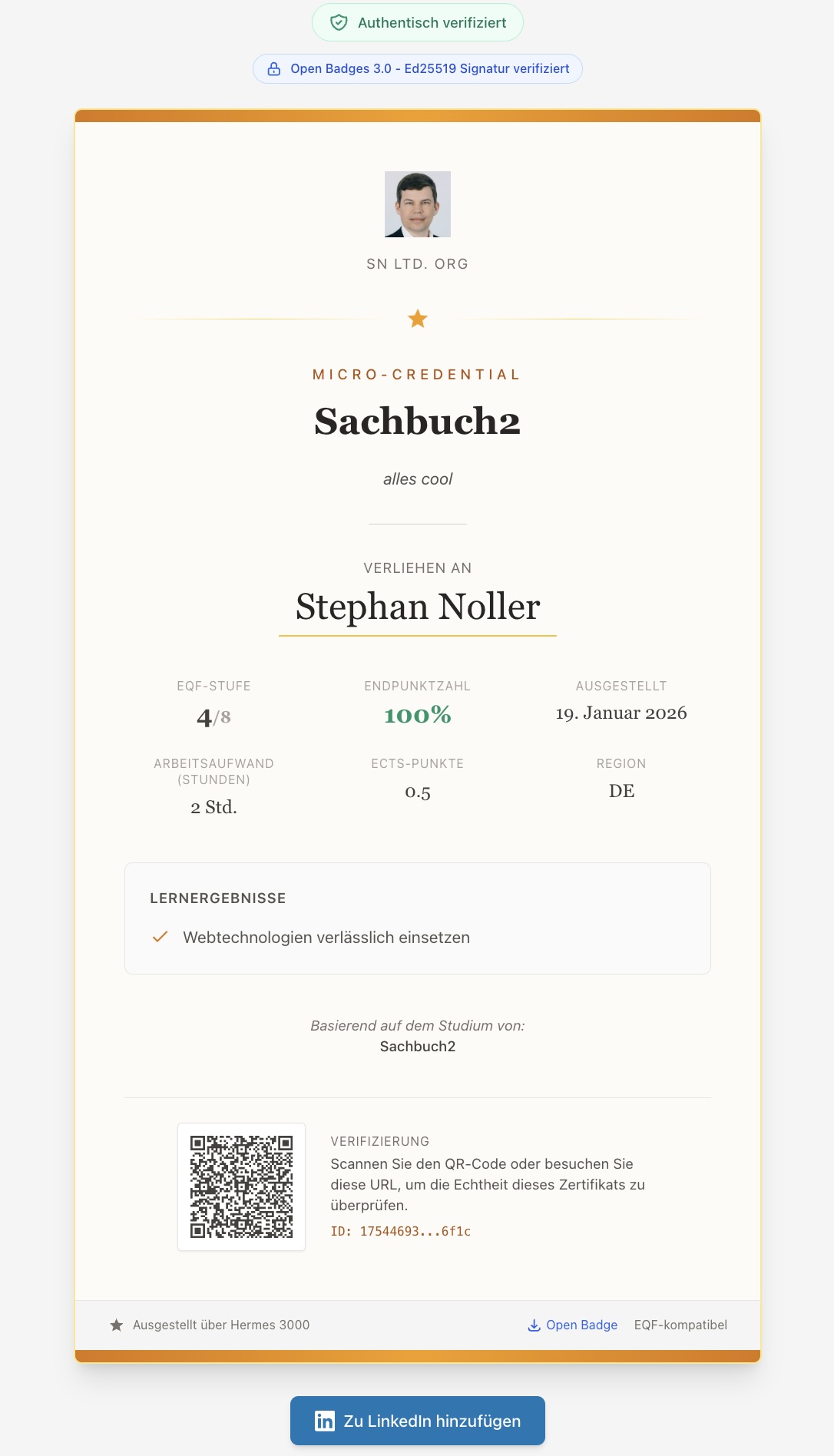
- Create credential: Learning outcomes are captured in a structured format – which book, which chapter, what score.
- Standard format: This data is converted into the Open Badges 3.0 format – an internationally recognized standard for digital educational credentials.
- Sign: The credential is signed with our private key and converted into a so-called VC-JWT (Verifiable Credential JSON Web Token).
- Deliver: The signed badge is available to the learner – for download, sharing, or embedding in LinkedIn.
What Makes the Badge Tamper-Proof?
Security is based on asymmetric cryptography:
- Private key: Remains exclusively on our server. Only we can sign badges.
- Public key: Freely available to anyone. Enables verification.
If even a single character in the badge is changed – whether the name, date, or score – the signature becomes invalid. The mathematical binding between content and signature is absolute.
Standards: Why They Matter
Our system is fully compatible with:
Open Badges 3.0 (1EdTech)
The international standard for digital educational credentials. A Hermes 3000 badge can be read and verified by any Open Badges 3.0-compatible platform – including LinkedIn, Credly, and hundreds more.
W3C Verifiable Credentials
The World Wide Web Consortium's data model for verifiable digital credentials. Our badges follow this specification exactly.
European Qualifications Framework (EQF)
Each credential can be assigned an EQF level. This helps employers and educational institutions classify the qualification – comparable across Europe.
Verification: How It Works
External validators – whether employers, universities, or other platforms – can verify our badges through a standardized process:
- Retrieve public key: Via a standardized endpoint (JWKS)
- Mathematically verify signature: Using established cryptographic libraries
- Validate content: Structure and required fields conform to the standard
The entire verification process happens without access to our database. This is the crucial difference from simple token or hash solutions.
Why Not Blockchain?
Blockchain-based certificates are popular, but we deliberately chose against them:
- Energy consumption: Proof-of-work blockchains are energy-intensive
- Immutability: Erroneous entries cannot be corrected (GDPR problem!)
- Complexity: Additional dependencies without real added value for our use case
Cryptographic signatures offer the same tamper-proof security – more efficiently, more flexibly, and more privacy-friendly.
What This Means for Authors
As an author on Hermes 3000, you can offer your readers genuine, verifiable credentials:
- Credibility: No DIY PDFs, but internationally recognized standards
- Reach: Badges can be embedded in LinkedIn profiles
- Independence: Verification works even if Hermes 3000 were offline
Outlook
The current implementation is just the beginning. Planned extensions:
- Author-specific keys: Each author could sign their own credentials
- Visual badges: PNG images with embedded signature ("Baked Badges")
- Revocation lists: For cases where a credential needs to be withdrawn
Conclusion
What initially sounds like a "nice feature" is actually a full implementation of established standards:
- Real cryptography instead of simple hashes or tokens
- International standards for maximum interoperability
- Offline verification without dependency on our platform
A badge from Hermes 3000 stands on the same technical level as credentials from LinkedIn Learning or Coursera. The difference: with us, any non-fiction author can use this technology for their readers.
Real educational credentials, cryptographically secured, standards-compliant – that's the future of learning with books.