In short: Writing a book with AI does not mean pressing a button. You decide the idea, the characters, the plot and the chapters, and you write the scenes that carry your book. The AI drafts and offers variants, gives feedback, finds contradictions and keeps track of hundreds of pages. You decide what stays. A chatbot like ChatGPT is enough for single steps. For a whole book you need a writing program that knows your manuscript and takes you all the way to a print-ready book. In Hermes 3000 the first 50 standard pages (90,000 characters) are free; after that a novel costs a one-time 59 EUR (first book 29 EUR) or the membership 19 EUR a month (as of November 2026).
"Can I write a book with AI?" Yes. The question is how much you leave to the AI, and where. This guide walks through the whole process in seven steps, from the idea to the printed book, followed by the mistakes we see most often and what a chat window cannot do for a whole book.
What does "writing a book with AI" actually mean?
AI can help in three places. They differ in how much the AI knows about your book.
| Kind of help | What the AI does | What it knows about your book | Examples |
|---|---|---|---|
| Correction | spelling, grammar, style within a sentence | only the selected text | Grammarly, LanguageTool |
| Chat assistant | ideas, outlines, single scenes, rewording | whatever you paste into the conversation | ChatGPT, Claude, Gemini |
| Writing program with AI | drafts, feedback, consistency checks, typesetting | the whole manuscript: characters, places, plot, earlier chapters | Hermes 3000, NovelCrafter, Sudowrite |
For a book of 300 pages the third kind is the one that matters. A novel runs 70,000 to 100,000 words, a non-fiction book 40,000 to 60,000. Turning that into a coherent whole needs an AI that still knows chapter 3 while you write chapter 17. What each program can do is in our comparison of Hermes 3000, NovelCrafter, Sudowrite and Papyrus.
Writing a book with AI in 7 steps
Step 1: Sharpen the idea and the premise
Start with one sentence that describes your book: who wants what, and what stands in the way? Here the AI is a good sparring partner. Let it play through "what if" variants, collect title ideas or ask who the book is for. Do not adopt anything blindly; the suggestions are raw material for your own thinking.
Step 2: Give your characters depth
Flat characters kill any story, and an AI without guidance reaches for stereotypes. So give each main character more than an age and a look:
- Desire and fear: what does she want, what does she dread, where does she contradict herself?
- Voice: how does she talk? Which words would she never use?
- Relationships: how does she stand with the others, and what remains unsaid?
An example: once you establish that your protagonist Sarah has a dry sense of humour and a fear of heights, the AI knows it in every scene at the edge of a cliff without you repeating it. If you already have a manuscript, the Story Atlas in Hermes 3000 reads characters, places and plot from it instead of you typing them up.
Step 3: Plan the plot and the chapters
Settle the basic structure before you write: three acts or another model, the important turning points, a rough sequence of scenes per chapter. The AI can propose a first chapter plan from a premise. Rework it until it tells your story rather than the most obvious one.
Step 4: Set your style
The biggest risk of writing with AI is a book that sounds like AI: smooth, uniform, interchangeable. The remedy is to show the AI your style rather than describe it. In Hermes 3000 you store two to five samples of your own writing; the model reads them with every generation and follows your sentence length and tone. For non-fiction you record your stance in the "My take" field: opinions, doubts, your own examples. That keeps the AI from writing the averaged textbook voice.
Step 5: Write, and write the key scenes yourself
Not every page is worth the same. The scenes at the heart of your book are yours to write: the moment the heroine loses everything, the final confrontation, the passages where your voice should be heard. The AI is strong at everything in between.
| You write | The AI helps with |
|---|---|
| key scenes and turning points | transitions between scenes |
| emotional climaxes | descriptions you already see in your head |
| dialogue that defines a character | variants of a phrase to choose from |
| the first sentence, the ending | drafts of minor scenes that you revise |
Three ways of working have proved themselves:
- AI as an idea generator: you write a paragraph, the AI proposes three continuations, you pick or combine.
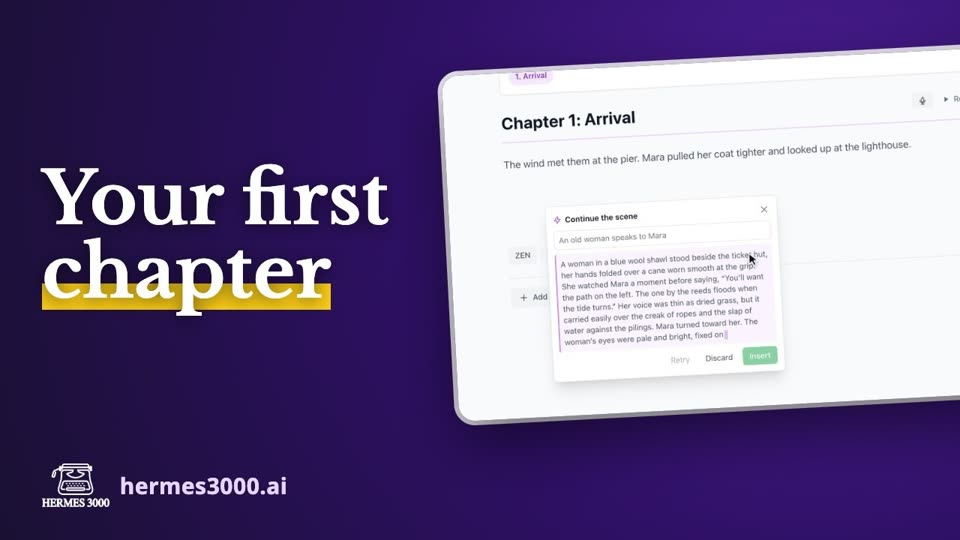
- Scene draft: you describe what should happen, the AI writes a first draft, you revise it.
- Feedback only: you write everything yourself and let the AI read and comment.
How you phrase the request makes the difference:
| Too little | Better |
|---|---|
| "Write chapter 7." | "Chapter 7: Sarah arrives in Rome and meets Marco for the first time. She is wary because of her ex. She is looking for the artefact from chapter 5. Rome in high summer, hot, full of tourists. Light, with humour and inner monologue." |
| "Write an action scene." | "A chase through the old town of Seville. Sarah flees from two men and, despite her fear of heights, climbs across a roof. Tense but believable, about 300 words." |
In a writing program you no longer have to put characters, places and earlier chapters into every request; the AI knows what is already in the book. The purpose of the scene, though, only you know.
Step 6: Revise with feedback
The first draft is never the book, with or without AI. Revision is where AI is most valuable, because it can see the whole manuscript at once:
- Contradictions: does the side character suddenly have blue eyes instead of green in chapter 5? Does a brother turn up who did not exist before?
- Suspense: in Hermes 3000 a tension curve above the editor shows where your novel sags. Against the ratings of 23 real readers of E. T. A. Hoffmann's "The Sandman" it correlates at 0.74 (how it is built).
- Style and readability: sentence length, repetitions, filler words, share of dialogue, counted over the whole book rather than estimated.
Do not let the AI rewrite everything. Use its analysis as input for your own revision, and accept or reject the changes it proposes one by one.
Step 7: From manuscript to book
A finished manuscript is not yet a book. For BoD or Amazon KDP you need a print-ready PDF with the right trim size, margins and running heads, an e-book in EPUB and a cover with the correct spine width. That is typesetting, not text generation. Hermes 3000 typesets the book itself and computes the spine from the page count; the details are in our guide to printing your book with BoD and KDP.
Amazon asks at publication whether content was generated with AI. A provenance record keeps track of which parts you wrote and where the AI helped, so you can answer that question honestly.
Can you write a book with ChatGPT?
Yes, for single steps. ChatGPT is a good partner for ideas, outlines, single scenes and reworking paragraphs. For a whole book the chat window shows its limits:
| ChatGPT | Writing program with AI (Hermes 3000) | |
|---|---|---|
| Ideas, scenes, rewording | yes | yes |
| AI knows characters, places, earlier chapters | only what you paste in | yes, the whole manuscript |
| Rearranging chapters, structure | no | yes |
| Page counts and writing goals | no | yes |
| Consistency check across the whole book | no | yes |
| Typesetting for BoD and KDP, EPUB | no | yes |
With a long manuscript, writing in ChatGPT means pasting summaries and character lists into the conversation over and over again.
Which AI writes best?
We measured it rather than claiming it. In our open benchmark for book-length writing 14 models wrote 490 texts that were rated blind. GPT-6.1 Sol and Claude Opus 5.5 share the top; GPT-6 Luna offers the best balance of quality and cost and is the default for every book in Hermes 3000. In a second test we repeated a 2023 literature study with the models of 2026: back then AI stories passed 2 to 13 % of the literary tests, today 77 to 91 %. What the models still lack is originality. That is what you bring.
The most common mistakes
1. Treating the AI as a ghostwriter. "I tell it what it's about and it writes my book" produces interchangeable text. Without your perspective, knowledge and vision you get the AI's vision, not yours.
2. Not saying what the scene is for. Every scene needs a purpose. What should the reader feel, what is revealed, what is at stake? Without that the AI writes the obvious.
3. Keeping the first draft. The first suggestion is rarely the best; the third version is often much better. Ask for variants and choose.
4. Putting off the details. Details bring stories to life. Postpone them and you get generic descriptions. Invest early in your world and your characters.
5. More AI text to finish faster. Faster, yes; better, no. A book with 80 % AI text reads differently from one with 20 %. Find the ratio that suits your book, and keep writing some passages entirely without AI.
What does it cost to write a book with AI?
| Option | Cost | What is included |
|---|---|---|
| Hermes 3000, up to 50 standard pages | free | every feature, AI included |
| Hermes 3000, novel | one-time 59 EUR (first book 29 EUR) | one book with no length limit, typesetting, export |
| Hermes 3000, non-fiction | one-time 149 EUR (first book 59 EUR) | the same, with research and a source list |
| Hermes 3000, membership | 19 EUR a month (fiction), 49 EUR (all book types) | unlimited books, three-month minimum |
All prices include VAT, as of November 2026. The AI is included: you need no API key of your own and no extra ChatGPT subscription. Prices of other writing programs are in our comparison of the best AI writing tools 2026.
Frequently asked questions
Can AI write a whole book?
It can produce a great deal of text, even an entire manuscript. A good book rarely emerges on its own that way: without your vision, your characters and your revision, the text turns smooth and interchangeable. AI works best as a tool you direct.
What is the best program for writing a book with AI?
You need an AI that knows the whole manuscript and a path all the way to print. Hermes 3000 covers both and is the only one of the four we compared with a German interface; NovelCrafter and Sudowrite are strong in English, and with NovelCrafter you pay for the AI separately. The full comparison is here.
Can I sell a book written with AI on Amazon?
Yes. Amazon KDP asks at publication whether text, images or translations were generated with AI. More in our article on selling an AI-assisted book on Amazon KDP.
Can you tell that a book was written with AI?
Unedited AI text often shows: uniform sentence openings, the models' favourite words, smooth language without edges. The more you write yourself and the more of your own writing you show the AI, the more the book sounds like you.
Can I revise a manuscript I have already written with AI?
Yes. In Hermes 3000 you upload Word, PDF, Markdown or plain text, and the text arrives in full. Then you check it for contradictions, style, readability and suspense and typeset it for print.
What does it cost to write a book with Hermes 3000?
The first 50 standard pages are free with every feature. After that you pay a one-time 59 EUR per novel (the first book 29 EUR) or use the membership from 19 EUR a month (as of November 2026).
Try it with your own project: create your book in Hermes 3000 or import what you have already written. The first 50 standard pages are free.