In short: Yes, an AI can take a lot of work off your hands when planning a workshop, as long as it knows the whole process and not just the slides. In Hermes 3000 you create a project of the type “Seminar / Slides”. Every chapter becomes a module. Seminar planning puts the day on a timetable, you write the slides directly into the modules, the AI creates a quiz per module, and everyone who passes receives a verifiable micro-credential following the EQF standard. Beforehand a questionnaire goes to the group, afterwards the transfer buddy accompanies every participant. Up to 50 standard pages it is free; after that a seminar costs €149 (the first one €59), or it is covered by the All-Inclusive membership (as of November 2026).
A workshop is rarely just slides. There is an agenda with breaks, content the participants should understand, a check whether they did, and the hardest part: getting what they learned into their work the Monday after. Usually that lives in five files and three tools. In Hermes it lives in one project, and the AI knows all of it.
The video: a workshop in three minutes
The steps at a glance
| Step | What you do | What Hermes contributes |
|---|---|---|
| 1. Set up modules | Create a “Seminar / Slides” project, plan modules as chapters | the outline assistant suggests modules |
| 2. Plan the day | Turn on seminar planning, set times and breaks | an agenda with times and notes |
| 3. Content and slides | Write the text per module, add slide separators | the AI writes along if you want, slide view in the reader |
| 4. Check understanding | Generate and review a quiz per module | questions drawn from the module’s text |
| 5. Certificate | Set up a micro-credential | a verifiable EQF certificate for everyone who passes |
| 6. Ask beforehand | Send a questionnaire to the group | the AI drafts the questions and summarises the answers |
| 7. Follow up | Enable the transfer buddy | a chat per person that knows the workshop |
1. Modules instead of chapters
The “Seminar / Slides” project type turns every chapter into a module. That sounds like a renaming, but it changes how the AI works with you: it writes for learners, not for readers of a novel, with clear learning goals, examples and exercises. If you already have material, a script, a deck, notes, you can import it or put it into a knowledge collection. The AI then draws on it while writing instead of guessing.
2. Putting the day on a timetable
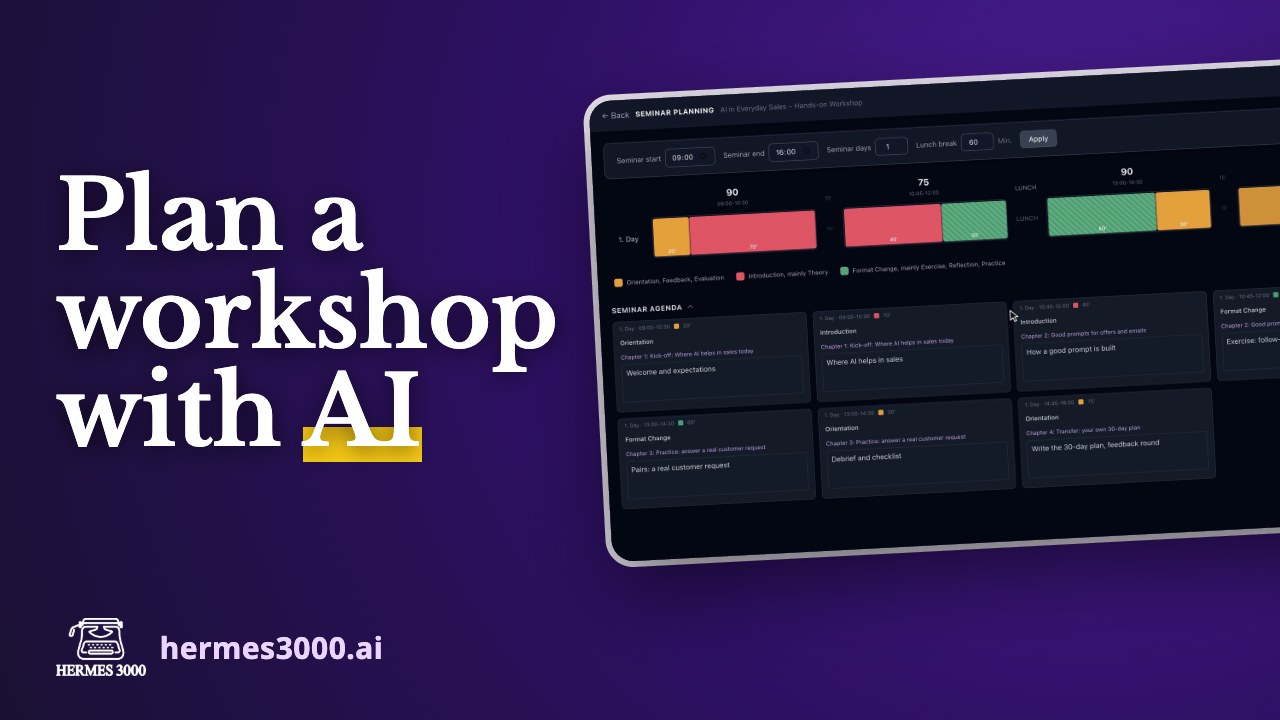
Seminar planning assigns the modules to one or more days, with times, breaks and lunch. Each block can carry notes: which method, which material, what you need to prepare. The result is an agenda you can send to the group, and an overview for you of whether the day is realistic.
3. Slides where the content is
You do not write slides in a second program but in the module itself. A slide separator splits the text into slides. In the reader you switch between running text and slide view. The advantage: slide and explanation stay together. Whoever reads the materials later sees not just bullet points but also what you would have said about them.
4. Quiz and micro-credential
For every module the AI creates a quiz from the module’s text. You review the questions, change what does not fit and decide when it counts as passed. Everyone who passes receives a micro-credential: a certificate following the European EQF standard, with its own verification page and QR code, which can be added to LinkedIn, for example. For training providers that is the difference between “attended” and “demonstrably understood”.
5. Knowing beforehand who is coming
On the book card, ⋮ → “Participants” holds the list of your group. From there you send a questionnaire in advance: the AI drafts questions that fit your seminar, participants answer through a link without signing up, and Hermes summarises the answers. So before the first module you know where the group stands and which questions it brings.
6. Afterwards: the transfer buddy
Most of what is learned in a workshop gets lost in the weeks after it, because nobody asks how it is applied. That is what the transfer buddy is for: every person gets a personal link to a chat that knows the content of your workshop. There they can ask how a method applies to their own situation, and the buddy answers based on your material, not on general internet knowledge.
What it costs
| Option | Price (incl. VAT) | Good for |
|---|---|---|
| Try for free | up to 50 standard pages, all features | trying out one workshop |
| Unlock one seminar | €149, the first seminar €59 | individual workshops |
| All-Inclusive membership | €49 a month or €490 a year | regular trainings, all book types |
As of November 2026. Fair monthly limits apply to a few compute-heavy services in the All-Inclusive membership; writing, quizzes and seminar planning are not among them.
What the AI does not do for you
Hermes plans with you, not instead of you. The methods that suit your group, the examples from your practice and the sense for when the room needs a break come from you. A quiz built from the text checks whether the text was understood, not whether someone has mastered the skill. And the transfer buddy does not replace a conversation with you; it keeps the content alive between two sessions.
Frequently asked questions
Can an AI plan a workshop?
It can suggest structure, agenda, slide text and quiz questions and keep everything in one place. Deciding what the group needs stays with you. In Hermes 3000 the AI works with your own material, not with templates from somewhere else.
Do I need PowerPoint for the slides?
No. Slides are created inside the module with a slide separator and shown as a slide view in the reader. The materials can also be downloaded as PDF or Word.
What is a micro-credential?
A small, verifiable certificate for a completed learning unit. In Hermes it follows the European EQF standard and has its own verification page with a QR code.
Do participants have to sign up?
No. Questionnaire, materials and transfer buddy work through personal links you send them from the participants area.
What does a seminar cost in Hermes 3000?
Free up to 50 standard pages, then €149 per seminar, the first one €59. The All-Inclusive membership (€49 a month or €490 a year) covers all seminars. As of November 2026.