In short: A report you can rely on comes out of an AI when the sources exist before the text and the text is checked again afterwards. In Hermes 3000 it works like this: you start a project of the type “Whitepaper & Reports” with web research, choose a thesis, let the AI build the outline, collect citable sources with links using the evidence assistant, and only then does the AI write the sections – based on those sources. Afterwards the fact check verifies every statement on the web, and the content becomes an infographic and an executive summary. Up to 50 standard pages it is free; after that a white paper costs €24 (the first one €6), as of November 2026.
Most AI reports do not fail at the writing but at the evidence. A language model finds a convincing number easier to produce than a correct one, and a citation that looks real is more likely for the model than an honest “I don’t know”. That is why the workflow in Hermes reverses the usual order: research and sources first, then text, then checking.
The video: a report for 2027
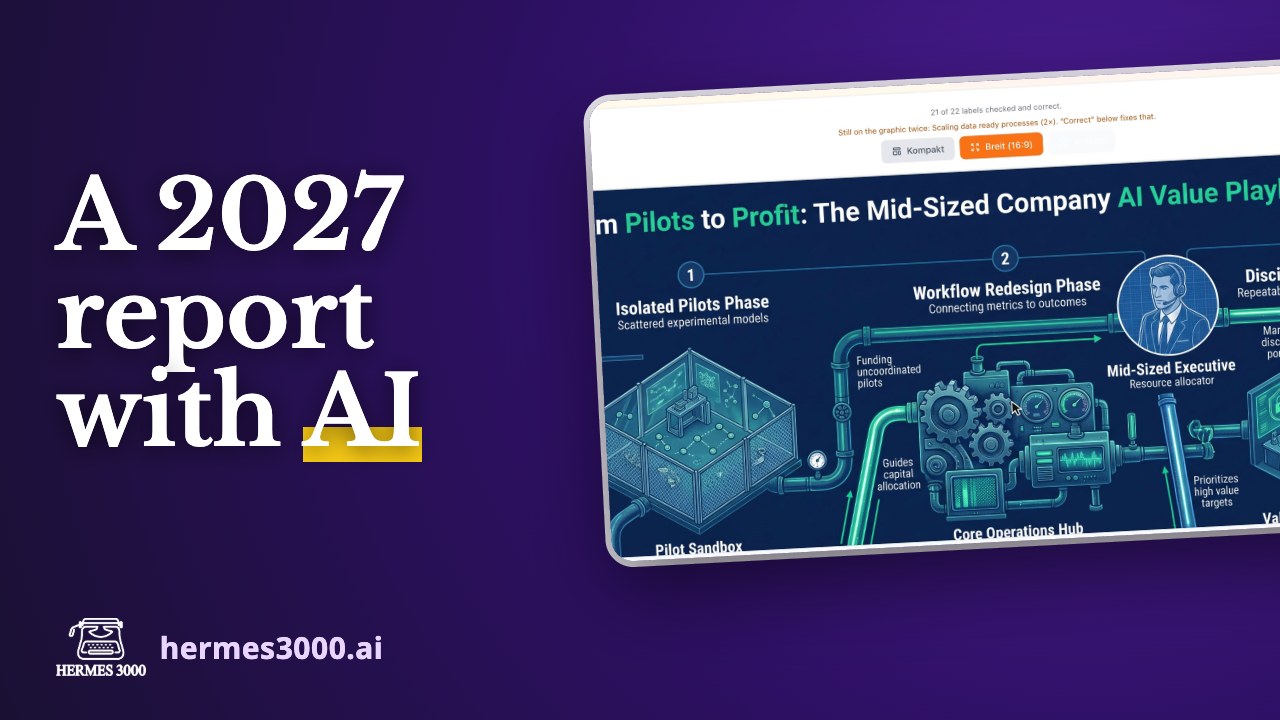
The workflow at a glance
| Step | What happens | What for |
|---|---|---|
| 1. Research | Hermes searches the web for the current state of the data and suggests topics with a thesis | no blank page, a solid starting point |
| 2. Thesis | you choose and sharpen the thesis, the argument assistant helps | the report makes a claim, not just covers a topic |
| 3. Outline | the AI suggests the sections | a structure you adjust |
| 4. Sources | the evidence assistant finds citable sources with links | evidence exists before text does |
| 5. Writing | the AI writes sections based on those sources | statements rest on the evidence |
| 6. Survey | a question to a panel of real respondents, answers computed by an AI model | your own figures on a representative base, labelled as synthetic |
| 7. Fact check | every statement is checked on the web, with sources and correction suggestions | find errors before others do |
| 8. Wrap-up | infographic and executive summary from the content | what decision-makers read first |
| 9. Output | share as an interactive document, PDF, Word or web page | the report reaches its readers |
1. Start with research instead of a blank page
When you create a white paper you can start “with research”. Hermes searches the web for the current state of your subject and suggests several topics, each with a thesis. In the video it is “AI in mid-sized companies 2027”. You pick one, drop the others or write your own.
2. A thesis you can defend
A report without a thesis is a collection of material. The argument assistant helps sharpen it: what exactly are you claiming, for whom, and what would show that you are right? From that, the outline assistant builds the structure. You move, cut and add sections until it holds.
3. Sources first, not afterwards
This is the most important difference. The evidence assistant finds citable sources with real links for your topic and files them under “Evidence & sources”. Since November 2026 the AI uses exactly these sources when it writes the sections: it bases statements on them, names the source in the text and invents no further studies or figures. So while reading the draft you already see what a statement relies on, and you can open the source yourself.
4. A survey – and what it is
With the survey block you ask a question, for example “How important will AI be for your company in 2027?”, and the result lands in the section as a chart, broken down by age, gender and place of residence. Important for putting it in context: behind the panel are real people, respondents of the Eurobarometer, the EU’s regular population survey. Their answers to your question, however, are synthetic: an AI model statistically derives, from what these people answered in the real surveys, how they would answer your new question. Because the Eurobarometer surveys a representative sample, the sample behind the panel is representative too. That gives you your own figures quickly where a real survey would take weeks. In a published report you should state the method, i.e. “synthetic answers based on Eurobarometer respondents”, and not present the figures as a conventional poll.
5. The fact check
Once the text stands, the fact check verifies its statements on the web. For every issue you get the sources it found and a suggestion for what it should say. Accepting or rejecting is up to you. It sees the open web, no paywalls and no internal data; what it does not find is not automatically wrong, only unsupported.
6. Infographic and executive summary
From the finished content Hermes creates an infographic with the key findings and an executive summary: thesis first, then problem, findings and recommendations, in the language of a document, not of a book blurb. Both are what many readers of a report see first, and often the only thing.
7. How the report goes out
You share the report as an interactive document via a link, download it as PDF or Word, or publish it as its own web page. The text stays in Hermes; when the numbers change in 2027, you update it in one place.
What it costs
| Option | Price (incl. VAT) | Good for |
|---|---|---|
| Try for free | up to 50 standard pages, all features | your first report |
| Unlock one white paper | €24, the first one €6 | individual reports |
| All-Inclusive membership | €49 a month or €490 a year | regular reports, all book types |
As of November 2026. Fair monthly limits apply to a few compute-heavy services, about three times as high in the All-Inclusive membership.
What you should check yourself
The order sources–text–check makes errors rarer, not impossible. Open the sources your most important statements rest on and read them yourself. Check figures that are meant to carry a decision against the original source. And state next to the survey figures that the answers are synthetic. A more detailed approach for longer white papers is in our step-by-step guide.
Frequently asked questions
Can I write a report with AI without it inventing sources?
It cannot be ruled out entirely, but it can be made much rarer: by collecting the sources before the text and instructing the AI to rely only on them. Afterwards the fact check verifies the statements on the web once more.
Are the survey results real data?
The respondents are real, the answers are not. The panel consists of real Eurobarometer respondents; how they would answer your question is computed by an AI model from their actual answers in earlier surveys. The sample is as representative as the Eurobarometer itself; the result is a statistically derived estimate and should be labelled with that method in the report.
How long does a report take?
It depends on the length. Our white paper guide estimates about four hours for 15 pages, checking and sharpening included. The more rests on the claims, the more time belongs in the checking.
Which formats can I output the report in?
As an interactive document via a link, as PDF, as a Word file or as its own web page.
What does a white paper cost in Hermes 3000?
Free up to 50 standard pages, then €24 per white paper, the first one €6. The All-Inclusive membership (€49 a month or €490 a year) covers all book types. As of November 2026.